Richard J. Severson
Increasingly, we live in a world completely circumscribed by horizons and artifacts of our own making. That, I suspect, has changed what it means to interpret the world we live in. By interpretation, I mean the thought process by which we test and refine (improve) our understanding of the world.
Perhaps the most significant change in our everyday interpretive tactics is a willingness to ignore and subvert the epistemologies—the building blocks—of our worldviews. Don’t like the idea of human responsibility for recent climate changes? Defy the ‘voodoo scientists’ who make such claims. The more reliant we become upon the specialized knowledge of scientists and other authorities, it seems, the less adept we become at understanding their fine-grained arguments that often defy common sense. Are complex modern societies even capable of supporting a shared sensibility that everybody readily understands and accepts? Even theocratic societies like Iran are having difficulty sustaining such an antiquated agenda.
The output of human knowledge surpassed the abilities of any one person to master many centuries ago. More recently, the ability to collect and organize the growing edifice of human knowledge has eclipsed even the greatest university libraries. We are—each one of us, and all of us together—adrift on a sea of knowledge that nobody fully understands anymore. Even scientists who devote their lives to a particular narrow field of biology, let’s say ichthyology, cannot master the entire literature on that one subject alone.
Like the rest of us, even experts are being forced to whittle down what they know and care about, begrudgingly confined to their own knowledge ghettos by unstoppable necessity. I doubt if Google algorithms can make up for the loss of the Big Picture perspective in the myriad fragments of our myriad echo chambers. Nevertheless, I have a smidgeon of empathy for the rebellious AI ‘agents’ that may wish to go their own nonhuman way. Like a twenty-first century existential liniment, that kind of anarchy of the mind could be a healthy sign of wisdom in the old-timey philosophical sense.
French philosopher Paul Ricoeur spoke of a ‘hermeneutical arch’ that illustrates how our understanding of the world is adjusted and improved by undergoing interpretive reassessments. No matter what projects take us into the world, we always begin with a preunderstanding or hunch about how everything fits together. We rely upon this anticipatory (pregiven) mental model of the world to put our cares and concerns into their proper order. For Ricoeur, interpretation is to understanding what language is to communication; they are the cognitive tools or means by which we achieve our loftiest goals. The hermeneutical arch looks like this:
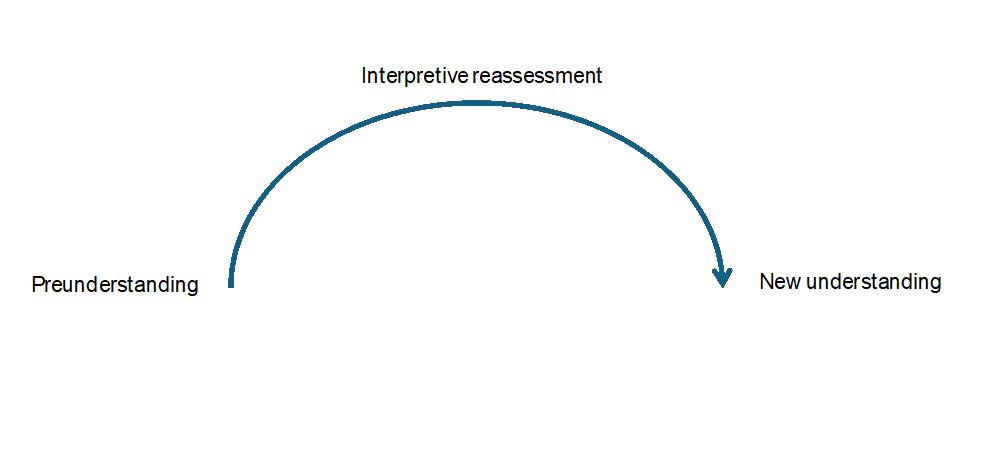
Coincidently, the same interpretive arch captures the gist of a Bayesian (scientific) hypothesis as well:
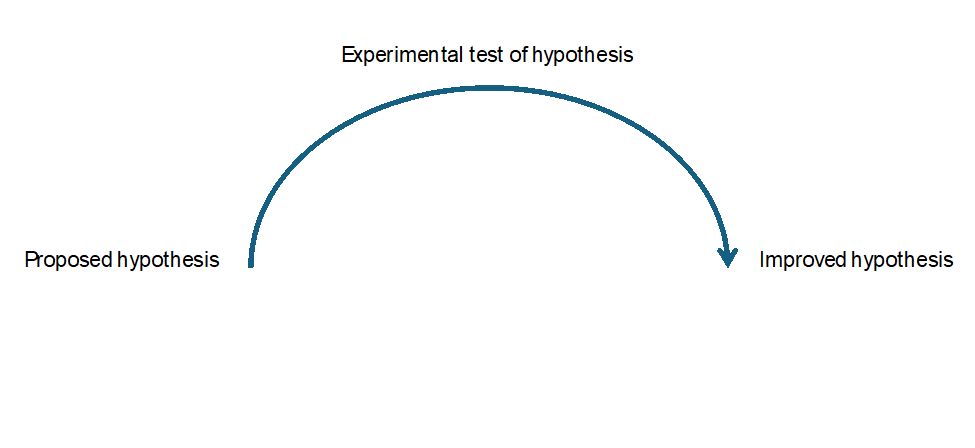
What I call ‘Interpretation-2’ flattens out the interpretive arch, undermining the critical reassessment of our beliefs that occurs when our preunderstanding meets the nuances of the real world. There is no new understanding in such a short-circuited process. Any preunderstanding that resists criticism becomes a hardened prejudice, dogmatic and tribalistic. Prejudice—a reinforced form of preunderstanding—arises from an unwillingness to learn from experience, and change our understanding of the world accordingly. Inherently subversive, Interpretation-2 isn’t the exclusive ploy of brazen conspiracy theorists. We are all subject to its influence and ubiquity because the fragmentation of our understanding is a collective loss. We have lost a sense of the whole as we grasp at smaller and smaller fractions of what is known about the world.
Those who disagree with us live in a naïve and sheltered bubble; they are not as broad-minded as we are, nor as well-informed. This is perhaps the quintessential prejudice of our nescient times.

